
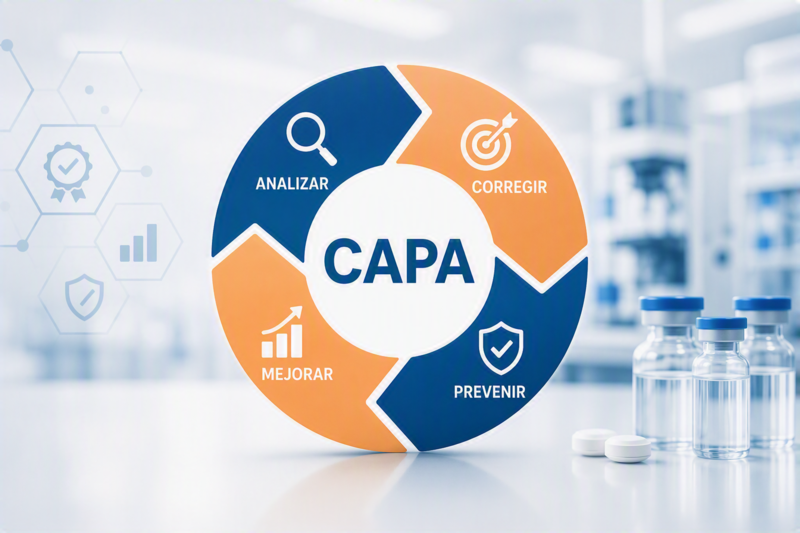
In any Quality Management System (QMS), especially in regulated environments such as the pharmaceutical industry, CAPA (Corrective and Preventive Actions) They are a key tool to guarantee continuous improvement, regulatory compliance and operational robustness. However, in practice, many CAPA systems become just another bureaucratic procedure, losing their true value.
Why is this happening? And how can you design a truly effective CAPA system?
What is a CAPA and why is it critical?
A CAPA is a structured process to:
- Correct an existing nonconformity (corrective action)
- Eliminate the root cause to avoid its repetition
- Prevent the emergence of potential problems (preventive action)
In frames like ISO 9001, I Q10 or the GMP, the CAPA is not only a documentary requirement, but a direct indicator of the quality system maturity.
Top reasons why CAPAs fail
1. Poor root cause identification
One of the most common reasons why a CAPA does not achieve the expected results is insufficient root cause analysis. In many investigations, a person responsible or a visible circumstance is quickly identified, but It does not delve into the factors that really caused the problem.
A common example is that of a deviation detected during the manufacturing of a batch. After investigation, the incident is attributed to a “human error” and the training or retraining of the personnel involved is established as a corrective action. However, when the deviation occurs again months later, it becomes clear that the real cause had not been correctly identified.
In most cases, behind alleged human error there are deficiencies related to the design of the process, unclear instructions, insufficient controls or organizational problems. When the analysis is done superficially, or under pressure to close the CAPA quickly, it is difficult to get to the true cause of the problem.
2. Corrective actions that do not correct
Another common mistake consists of implementing actions that, although easy to execute, have a limited impact on the recurrence of the deviation. Measurements like remember a procedure, increase surveillance O provide training additional may be necessary in certain situations, but are rarely enough on their own.
These types of actions usually act on the consequences of the problem rather than its origin. As a result, the risk may be temporarily reduced, but the root cause remains and the possibility of the incident occurring again remains.
3. Absence of a risk-based approach
Not all deviations have the same relevance, nor do all CAPAs require the same level of analysis. However, it is relatively common to find systems in which the same treatment is applied to minor incidents and problems that could significantly affect product quality or regulatory compliance.
The lack of prioritization generates saturated systems, consumes unnecessary resources and makes it difficult for the organization to focus its efforts on those problems that truly represent a risk to the business or the patient.
4. Evaluation of insufficient effectiveness
Efficiency is one of the most important aspects of any CAPA and, at the same time, one of the most neglected. Frequently, actions are considered closed once implemented, without checking whether they have managed to eliminate the problem in a sustainable way.
Evaluations carried out too early, the absence of objective indicators or the simple lack of incidents as the only criterion for success can offer a false sense of control. A CAPA can only be considered effective when there is sufficient evidence to demonstrate that the root cause has been eliminated or adequately controlled.
5. Poor integration with the quality system
CAPAs generate true value when they are part of an interconnected quality system. If the conclusions obtained during an investigation are not reflected in risk analyses, change management processes, audits or management reviews, much of the learning is lost.
The consequence is that the organization corrects specific problems, but does not take advantage of the opportunity to strengthen the system as a whole.
6. An organizational culture oriented towards closure and not improvement
Finally, no CAPA system can be stronger than the culture of the organization in which it is developed. When the primary objective is to close records on time or avoid findings during an audit, investigations tend to be simplified and corrective actions become less effective.
In contrast, organizations with mature CAPA systems encourage transparency, promote the incident communication and understand mistakes as opportunities to learn and improve. In these environments, the focus is on understanding the causes and strengthening the processes, not on finding blame.
How to design an effective CAPA
An effective CAPA is not limited to documenting a deviation or reactively implementing actions. You must follow a structured approach that allows identifying the real causes of the problem, implement sustainable solutions and verify its effectiveness over time.
| Stage | What does it imply? | Good practices |
| Clearly define the problem | Objectively describe what happened, when, where and what the impact was. | Base the description on data and evidence, avoiding premature interpretations or conclusions. |
| Real | Investigate the factors that have caused the deviation or non-conformity. | Use methodologies such as 5 Why or the Ishikawa diagram and validate the conclusions with objective evidence. |
| Dise | Establish measures capable of eliminating the identified root cause. | Prioritize changes in processes, systems or controls over merely training or administrative actions. |
| Apply a risk-based approach | Determine the level of depth and resources necessary according to the criticality of the problem. | Consider the impact on quality, patient safety, regulatory compliance, and likelihood of recurrence. |
| Implement and track | Execute the defined actions and supervise their implementation. | Assign responsible people, realistic deadlines and control mechanisms to guarantee execution. |
| Verify effectiveness | Confirm that the actions implemented have resolved the problem in a sustainable way. | Establish measurable indicators, appropriate monitoring periods and objective acceptance criteria. |
| Integrate learning | Take advantage of the information obtained to strengthen the QMS. | Update risk analysis, procedures, change management processes and audit programs when necessary. |
A simple rule to evaluate any CAPA
Before approving a corrective action, it is worth asking yourself a fundamental question:
Does this action eliminate the root cause or simply temporarily reduce the likelihood of the problem occurring again?
If the answer is the latter, the action probably needs to be reviewed and reinforced before the CAPA is considered adequate.
This reflection usually makes the difference between a CAPA that is closed administratively and a CAPA that generates a real and sustainable improvement in the quality system.
Case study: from a recurring deviation to an effective CAPA
Let's imagine a pharmaceutical plant dedicated to the manufacturing of solid oral forms.
During the periodic review of deviations, the Quality department detects that, in the last six months, several incidents related to errors in the completion of manufacturing records have been recorded. Although none of them have affected the quality of the product, all have required investigations, documentary reviews and delays in the release of batches.
| The initial approach: an ineffective solution | In early investigations, the root cause was attributed to a human error. As a corrective action, reinforcement training on Good Documentation Practices was scheduled for all operators involved.
However, deviations continued to appear. This scenario is common in many organizations: an apparent cause is identified and quick action is implemented, but the problem persists because the real source has not been addressed. |
| Going deeper into the research | Given the recurrence of the incidents, it was decided to carry out a more exhaustive root cause analysis using the methodology of the 5 Why.
The investigation revealed that:
The root cause, therefore, was not only related to the operator, but to the design of the documentary process itself. |
| Corrective action
|
Based on the findings, the organization decided:
Training remained as a complementary action, but it was no longer the main measure. |
| Verification of effectiveness | Monitoring was established for three months using specific indicators:
At the end of the evaluation period, a reduction of more than 80% in documentary deviations and a significant improvement in release times was observed. |
| Lesson learned | This example demonstrates a common reality in quality systems: when an investigation is limited to identifying “human error,” corrective actions are often weak and ineffective. On the other hand, when the process is analyzed in depth, it is possible to identify systemic causes and design sustainable solutions.
An effective CAPA does not simply seek to correct an error; seeks to understand why it happened and strengthen the system to prevent it from happening again. |
Conclusion
A CAPA should not be an administrative procedure, but rather a strategic tool for continuous improvement. The difference between a “compliant” system and one who really brings value resides in the quality of the analysis, the robustness of the actions and the organizational culture that supports it
Designing effective CAPAs requires technical rigor, focus on risk and a real commitment to quality.
Is your CAPA system generating real improvements or simply closing deviations?
In regulated environments, the effectiveness of corrective and preventive actions is a direct indicator of QMS maturity. If you need to optimize your investigation processes, strengthen your root cause analysis or improve CAPA management in your organization, our team can help you. Contact us and discover how to turn CAPA into a strategic tool for continuous improvement.