
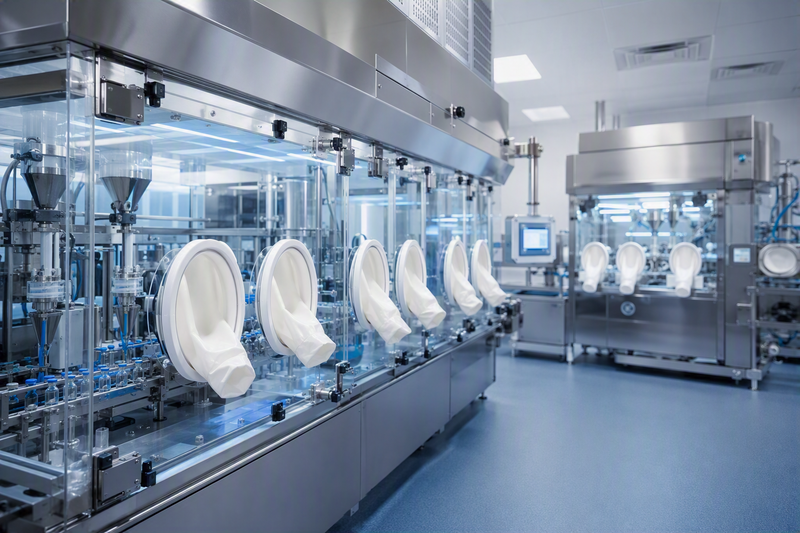
The manufacturing of sterile medications represents one of the greatest challenges within the pharmaceutical industry. The need to ensure product sterility throughout the manufacturing process has driven the continued development of technologies designed to minimize human intervention and reduce the risks of microbiological contamination and particulate.
Traditionally, aseptic processes were carried out in clean rooms with high environmental classification, where operators constituted the main potential source of contamination. However, the growing regulatory requirement and the search for higher levels of sterility guarantee have favored the implementation of advanced barrier systems such as Restricted Access Barrier Systems (RABS) and the insulators.
Today, these technologies are fundamental elements of modern sterile manufacturing, as they significantly reduce product exposure to the environment and increase the robustness of aseptic processes.
The challenge of aseptic processing
Unlike terminal sterilization processes, in aseptic processing the product does not receive a sterilizing treatment once its filling is completed. This implies that Any contamination introduced during manufacturing can directly compromise the quality and safety of the medication..
The main pollution sources include:
- Operators and their interventions.
- Equipment and contact surfaces.
- Materials introduced into critical areas.
- Deficiencies in HVAC systems.
- Inadequate operating procedures.
Regulatory investigations have consistently shown that personnel are the largest potential source of microbiological contamination in critical areas. As a consequence, the industry has evolved towards technologies capable of reduce or eliminate direct interaction between operator and product.
Barrier technologies to minimize the risk of contamination
The introduction of barrier systems marked a significant change in the design philosophy of sterile facilities. The objective changed from controlling only the clean environment to physically separating the operator from the critical process areas.
This evolution made it possible to reduce human interventions, reduce the potential microbiological load and improve the ability to maintain stable aseptic conditions during production.
What is a RABS system and how does it work?
RABS emerged as an intermediate alternative between conventional filling lines in clean rooms and totally closed systems.
A RABS consists of a rigid physical barrier that separates operators from critical production areas, allowing only limited interventions through integrated gloves or controlled access.
Types of RABS
| RABS abiertos | They maintain connection with the surrounding clean environment, typically a GMP Grade B classified room.
Its main features are:
|
| RABS closed | They present a higher degree of separation with respect to the external area.
Features:
|
| Advantages of RABS |
|
| Limitations |
|
What is a pharmaceutical isolator and what are its advantages?
The next stage in technological evolution has been the implementation of isolators, completely closed systems designed to provide a practically total physical separation between the product and the external environment.
An isolator constitutes a watertight envelope that incorporates handling gloves, material transfer systems and automated decontamination cycles.
The main objective is eliminate operator influence on the aseptic process.
Working principle of insulators
The insulators operate by:
- Controlled internal environment.
- Maintained differential pressure.
- HEPA or ULPA filtration.
- Secure transfers of materials.
- Automatic decontamination using sporicidal agents.
The most widespread technology uses vaporized hydrogen peroxide (VHP) for biodecontamination of internal surfaces before the start of production.
Classification of insulators
| Positive pressure isolators | They are mainly used for the manufacture of sterile products.
Features:
|
| Negative pressure isolators | Designed for highly potent or dangerous products.
Features:
|
| Hybrid insulators | Some modern facilities combine positive and negative pressure conditions in different chambers or operational phases, simultaneously optimizing sterility and containment. |
Comparison between RABS and isolators in sterile manufacturing
| Parameter | RABS | Insulator |
| Operator-product separation | Alta | Very high |
| Grade B room dependency | Yeah | Reduced |
| Pollution risk | Low | Very low |
| Integrated biodecontamination | Limited | Yeah |
| Investment cost | Moderate | Alto |
| Validation complexity | Media | Alta |
| Interventions during production | Possible | Minimum |
| Sterility guarantee | High | Very high |
From a Quality Risk Management (QRM) perspective, Isolators offer a significantly higher level of control, especially in aseptic filling processes of products of high value or high risk for the patient
Conclusion
The evolution from conventional lines to RABS systems and subsequently to isolators reflects the pharmaceutical industry's ongoing effort to reduce contamination risks and increase sterility assurance. While both technologies have significantly improved the safety of aseptic processes, isolators currently represent the most advanced level of protection between the operator and the product.
In the next article we will analyze how these technologies are integrated within the Contamination Control Strategy (CCS), the implications of Annex 1 of the GMP and the validation requirements associated with its implementation.