
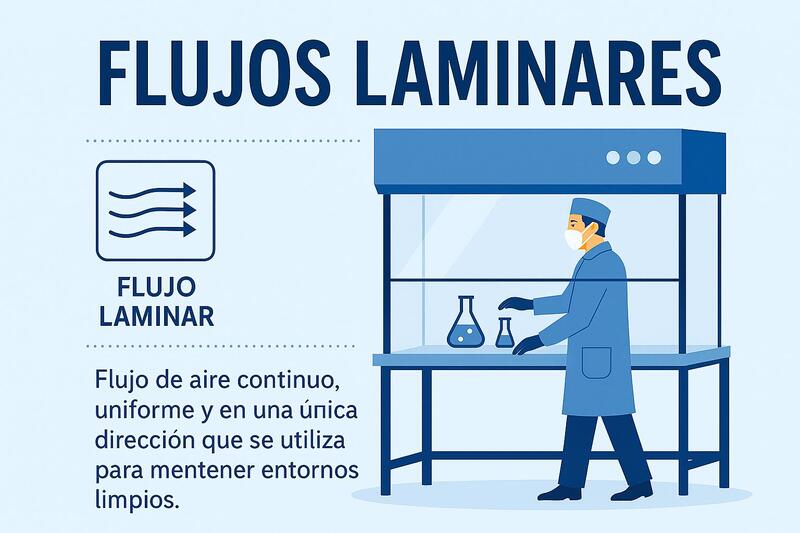
In the pharmaceutical and biotechnology industry, quality does not depend solely on procedures or staff experience. There are technical elements that, although they go unnoticed on a day-to-day basis, are decisive in guaranteeing product safety and regulatory compliance. Laminar flow systems are one of those invisible pillars that support critical processes in GMP environments.
Its main function is to create a controlled environment by supplying air filtered and Unidirectional, reducing the presence of particles and microorganisms to a minimum during especially sensitive operations. Sterile preparations, sampling, weighing or aseptic manipulations directly depend on this equipment working correctly and consistently.
Why laminar flow is key in critical GMP processes
The value of laminar flow lies not only in the equipment itself, but in the level of control it brings to the process. When working in conditions equivalent to ISO 5 or Grade A, the risk of contamination is significantly reduced, an especially relevant aspect in an increasingly demanding regulatory context.
Furthermore, laminar flows are usually one of the first points of attention during a GMP inspection. Its condition, maintenance, qualification, use and consistency with the process offer the inspector a very clear view of the actual level of control of the installation and the quality culture of the organization.
When bad design becomes a deviation
A well-designed laminar flow It is always the result of a prior reflection on the real use that is going to be given to it. Not all processes require the same type of protection Not all cabins respond the same to the environmental conditions or the behavior of the operator.
From a design point of view, the selection of the type of flow, the quality of filtration, the uniformity of the air and the absence of turbulence directly determine the effectiveness of the equipment. Added to this is the need for correct integration in the clean room, both from a technical and operational point of view.
In practice, many of the problems that are detected later (non-conforming flow visualization tests, out-of-specification results or difficulties in daily work) have their origin in design decisions poorly aligned with the real process.
Validation as proof of process knowledge
In regulated environments it is not enough for laminar flow to function correctly; It is essential to demonstrate it objectively and documented. Validation makes it possible to demonstrate that the equipment meets the requirements for which it was designed and that it maintains its performance under representative conditions of use.
Through the different phases of qualification and testing such as the integrity of HEPA filters, the measurement of air velocity, particle counting or flow visualization studies, it is built a solid base of technical evidence. However, the true value of this information appears when is interpreted and connected to the process, and not when it is limited to meeting a documentary requirement.
Mistakes that end in bigger problems
In many organizations, laminar flows only receive attention when a deviation or a out of trend result. However, the risks associated with inadequate design, weak validation or poor maintenance go far beyond a specific problem:
| Risk | What usually happens in practice | Potential consequences |
| Flow design not aligned with the process | The air pattern is disturbed by the operator, materials or environment; turbulence appears at the critical point | Increased risk of contamination, non-compliant smoke tests and inspector doubts about the suitability of the design |
| Validation not representative of actual use | Tests carried out at rest or without simulating the usual operation | Loss of credibility of validation and observations due to lack of evidence in real conditions |
| HEPA filter failure or degradation | Progressive loss of efficiency without early detection | Results out of specification, urgent revalidations and possible impact on the product |
| Reactive or poorly documented maintenance | Interventions without impact assessment or change management | Risk of loss of validated status and observations due to deficiencies in the quality system |
| Non-representative smoke tests | Visual studies that do not reflect operational reality | Critical observations for non-compliance with Annex 1 of the GMP and questioning of the CCS |
| Incorrect use by the operator | Unnecessary movements, flow blockage or poor disposal of materials | Reduced critical point protection and increased risk of contamination |
| Lack of specific training | Staff do not understand how the flow works or its impact | Repetition of operational errors and loss of control in the critical environment |
| Inconsistency between documentation and practice | What is described in procedures does not match the real operation | Loss of confidence of the inspector and observations due to lack of effective control |
| Insufficient change management | Changes in process, equipment or room without flow re-evaluation | Undetected impact on pollution control and need for CAPAs |
| Overdependence on equipment | Laminar flow is relied upon as the only control barrier | High risk if equipment fails and observations for weak contamination control approach |
The point where many organizations let their guard down
Once validated, the challenge is to keep the equipment under control over time. He maintenance It is, in this sense, a key element to preserve the validated state of the laminar flow and avoid deviations that could compromise the product.
One approach preventive, GOOD planned and correctly documented, allows you to anticipate performance degradation and manage changes in a controlled manner. In contrast, reactive management often results in urgent interventions, unplanned revalidations and a higher risk of impact on production and GMP compliance.
Laminar flows in the context of Annex 1
The revision of Annex 1 of the European GMP has clearly reinforced the regulatory expectations regarding pollution control, and laminar flows occupy a central place within this approach.
Annex 1 states that these equipment should be understood as technical barriers integrated within an overall pollution control strategy. This implies that its design, validation, maintenance and use must be aligned with a risk-based approach and clearly connected to the Contamination Control Strategy of the installation.
During an inspection, it is no longer only evaluated whether the laminar flow meets the required tests, but whether the organization is able to explain why that solution has been chosen, what risks it mitigates and how its effectiveness is guaranteed in daily use. Flow visualization studies take on a particularly relevant role here, since they allow demonstrate clearly and understandably that the air pattern actually protects the critical point.
The human factor: technology and behavior go hand in hand
No matter how advanced laminar flow is, its effectiveness depends largely on how it is used. Operator behavior remains one of the main potential sources of contamination, as Annex 1 explicitly recognizes.
Unnecessary movement, improper disposal of materials, or failure to follow cleaning practices can alter the flow pattern and reduce the expected protection. Therefore, the continuous training and awareness of staff They are elements as critical as the design of the equipment itself.
Conclusion
Laminar flows are much more than clean room equipment. They represent a connection point between engineering, quality, daily operation and regulatory expectations. In the current Annex 1 framework, its proper management has become a clear indicator of an organization's GMP maturity.
A well-designed, judiciously validated, consistently maintained, and properly used laminar flow not only protects the product, but also conveys a clear message in an inspection: there is knowledge of the process, its risks, technical control, and a strong quality culture.
Do you want to know if your laminar flows would withstand an inspection today?
The design, validation and maintenance of laminar flows are no longer evaluated in isolation. In the current context of Annex 1, they are a key piece within the global pollution control strategy and a common focus during regulatory inspections.
If you are reviewing your CCS, preparing a inspection, facing a revalidation or you simply want to confirm that your laminar flows are aligned with current expectations, an independent technical review can make a difference.
Let's talk on how to reinforce the state of control of your laminar flows and reduce risks before they become observations.