
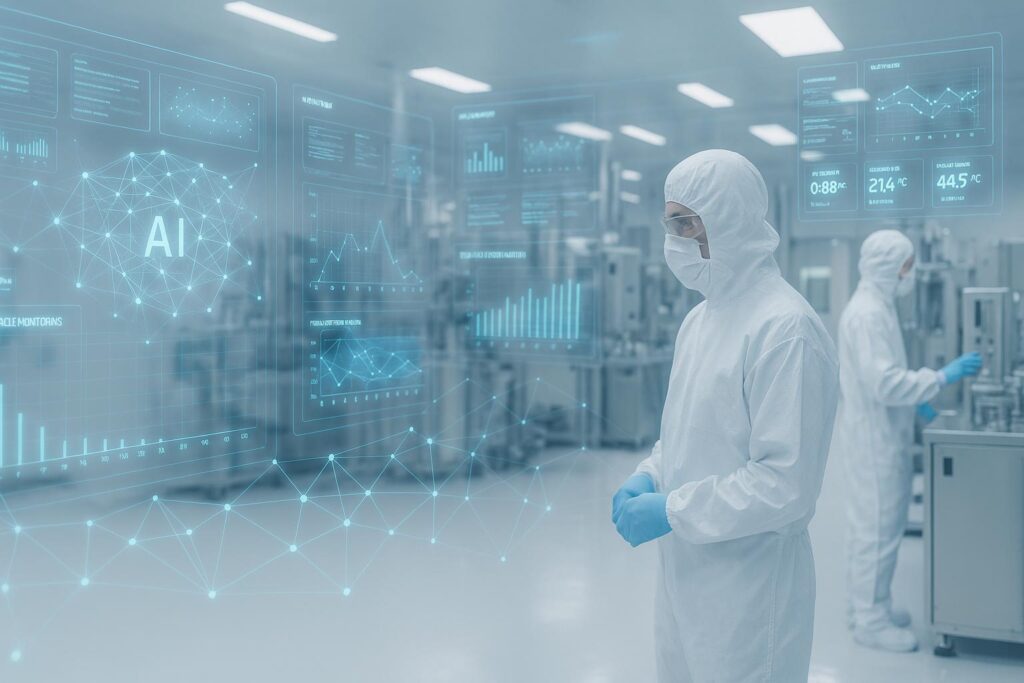
How AI is transforming environmental monitoring (EMS) from a reactive approach to data-driven predictive models
In pharmaceutical manufacturing, environmental control in clean rooms is a critical element to guarantee product quality, especially in aseptic processes. Traditionally, this control has been based on continuous monitoring systems supported by alert and action limits, together with retrospective trend analysis.
However, the increasing complexity of production systems and the massive availability of data from EMS systems are revealing the limitations of this fundamentally reactive approach.
In this context, artificial intelligence (AI) emerges as a key tool to evolve towards predictive models, capable of anticipating deviations, detecting anomalies early and improving risk management in GMP environments.
This technical guide analyzes how these technologies can be integrated into pharmaceutical clean rooms and what implications they have at the level of regulatory, technical and operational.
1. Environmental control in clean rooms: limitations of the traditional approach
Pharmaceutical clean rooms are designed to guarantee strictly controlled environmental conditions with the aim of minimizing contamination, both particulate and microbiological. These environments are based on HVAC systems complexes and networks of sensors that provide continuous information about critical variables like the particle concentration, Differential pressure, temperature and relative humidity.
In the conventional model, the evaluation of the control state It is fundamentally based on:
- Comparison against defined limits (alert/action).
- Retrospective trend analysis.
- Investigation of specific deviations.
This model, although aligned with regulatory requirements, presents a fundamental limitation: its reactive nature. In this context, AI emerges as a key tool to transform environmental control towards a predictive approach, based on the anticipation of deviations and the proactive identification of risks.
2. AI in GMP environments: regulatory framework and validation
The adoption of AI-based solutions in pharmaceutical environments must necessarily be evaluated through the prism of regulatory compliance.
He EU GMP Annex 1 (2022) reinforces the need to implement control strategies based on knowledge of the process and continuous monitoring of the environmental state. In this sense, the use of advanced tools for data analysis is not only compatible with the regulatory framework, but is aligned with its evolution towards risk-based approaches.
Likewise, the ICH Q9 guide promotes the systematic use of tools that improve the identification, evaluation and control of risks. AI, applied to the analysis of environmental data, constitutes a natural extension of these principles, allowing the evaluation of complex and dynamic relationships that escape traditional methods.
However, its implementation must guarantee compliance with the data integrity principles (ALCOA+), including traceability, consistency, auditability and control of the life cycle of models and algorithms.
3. Environmental Monitoring (EMS) Data: Basis for AI Application
One of the key factors enabling the use of AI is the availability of large volumes of data from multiple sources:
- Continuous particle counters
- Microbiological monitoring systems
- Temperature and humidity sensors
- Differential pressure control systems
- HVAC System Data
- Operational records (interventions, accesses, doors)
These data present particular characteristics: high dimensionality, time dependence and non-linear relationships. Effective exploitation of this information requires tools capable of processing large volumes of data and extract meaningful patterns, an aspect in which AI far surpasses classical statistical approaches.
4. Applications of AI in pharmaceutical environmental control
4.1 Advanced anomaly detection in clean rooms
Anomaly detection algorithms allow deviations from expected behavior to be identified without the need to explicitly define rigid thresholds. Through models like autoencoders, techniques clustering or methods based on density, you can detect:
- Progressive drifts in HVAC systems
- Subtle changes in particle behavior
- Anomalous patterns associated with operational activity
This approach is especially useful for identifying incipient events that would otherwise only be detected once action limits have been exceeded.
4.2 Predictive models to anticipate environmental deviations
Predictive models based on time series make it possible to anticipate the probability of environmental excursions, providing a action window before of the occurrence of a deviation.
Typical applications include:
- Prediction of increases in particle concentration
- Anticipation of failures in HEPA filtration
- Identification of risk conditions prior to microbiological events
These types of tools enable strategies predictive maintenance and improve the operational planning.
4.3 Multivariate analysis and process knowledge in GMP environments
One of the main advantages of AI is its ability to model complex relationships between variables. This allows us to delve deeper into the knowledge of the process and better understand the factors that influence the environmental behavior.
For example, it is possible to evaluate in an integrated way:
- The impact of door opening on differential pressure and particles
- The relationship between environmental conditions and microbiological results
- The influence of operating patterns on the control state
This knowledge facilitates data-driven decision making and strengthens the overall control strategy.
5. Impact of AI on GMP control strategy and control status
The incorporation of AI into environmental control has direct implications for the Pharmaceutical Quality System:
- Strengthens the focus of Continued Process Verification (CPV).
- Allows more dynamic management of control status.
- Reduces dependence on static limits.
- Improves the ability to respond to deviations.
From an operational point of view, it translates into a false alarm reduction, optimization of research effort and one higher efficiency in QA/QC resource management.
6. Challenges of AI in GxP environments
Despite its potential, implementing AI presents significant challenges:
| Validation | Models must be validated equivalent to any critical computer system, including:
|
| Explainability | Regulatory acceptability depends largely on the ability to explain how the model generates its results. “Black box” models can be problematic in audits. |
| Model governance | It is necessary to establish clear processes for:
|
| Technological integration | Coexistence with legacy systems (EMS, SCADA, LIMS) may require complex architectures and interoperability solutions. |
7. How to implement AI in clean rooms: practical approach
The introduction of AI in clean rooms must be addressed in a progressive and structured manner:
- Evaluation of the existing level of digitalization. The first step is to analyze the degree of digital maturity in the facility, including the availability, quality and integrity of data from systems such as EMS, SCADA or LIMS. It is essential to evaluate whether the data is complete, consistent and traceable, since the quality of the model will directly depend on the quality of the information used.
- Identification of high impact use cases. Not all AI applications provide the same value. Therefore, it is key to prioritize use cases where there is a clear impact on the reduction of deviations, the improvement of the control state or operational optimization. Typical examples include anomaly detection, prediction of particle excursions or optimization of HVAC systems.
- Development of controlled pilots. Before a large-scale implementation, it is recommended to develop pilot projects in limited environments. These pilots allow us to evaluate technical feasibility, validate hypotheses and quantify benefits without compromising the production system. In addition, they facilitate internal acceptance by demonstrating concrete results.
- Validation according to GAMP 5. AI models should be treated as critical computer systems, integrating into the established validation framework (GAMP 5). This involves documenting the model lifecycle, validating training data, verifying its performance, and ensuring its reproducibility and traceability.
- Gradual scaling and integration into the quality system. Once the pilot has been validated, the implementation must be carried out progressively, extending the solution to new areas or variables. This approach reduces risks, facilitates change management, and allows the model to be adjusted to different operating conditions before full adoption.
8. The implementation of AI is not a purely technological project, but an interdisciplinary initiative (QA, engineering, IT, production).
8.1 Future trends: AI and evolution of environmental control in clean rooms
The application of AI in the environmental control of clean rooms is still in a phase of progressive adoption, but its evolution points towards a significant transformation of the current monitoring and control model in GMP environments.
Below are some of the main lines of evolution that will mark the future of environmental monitoring in the pharmaceutical industry.
8.2 Integration with real-time control systems
One of the most relevant developments will be the integration of AI models directly into control systems (BMS/SCADA), allowing not only to analyze data, but also to act on the process in real time.
In this scenario, the models will be able to automatically adjust HVAC parameters, optimize differential pressuress and adapt environmental conditions depending on the operational activity.
This approach will allow us to evolve from passive monitoring systems to supervised active control systems, always maintaining human intervention as key element in GxP environments.
8.3 Use of digital twins (Digital Twins)
The creation of digital twins of clean rooms will allow simulating the dynamic behavior of the environment under different operating conditions.
These virtual models will be able to:
- Evaluate the impact of changes in layout or personnel flows
- Simulate deviation scenarios before they occur
- Optimize control strategies without the need to intervene directly in the plant
The combination of digital twins with real data and AI models will significantly improve process knowledge, aligning with the principles of Quality by Design (QbD).
8.4 Explicable models (Explainable AI, XAI)
As AI adoption increases in regulated environments, explainability of models will become a critical requirement.
Future solutions will tend to incorporate Explainable AI (XAI) techniques, capable of justifying model decisions in an understandable way, identifying key variables that influence a prediction and facilitating audits and regulatory reviews.
This will improve the confidence of both QA teams and regulatory authorities, overcoming one of the main current barriers: the perception of models as “black box”.
8.5 Automation of deviation management
Another relevant evolution will be the partial automation of the environmental deviation management process.
AI-based systems will be able to:
- Automatically classify events by criticality
- Suggest possible root causes based on historical patterns
- Prioritize investigations based on risk
This will significantly reduce the operational burden associated with QA/QC and improve efficiency in the management of the pharmaceutical quality system.
8.6 Integration with predictive maintenance strategies
AI will enable increasing integration between environmental monitoring and critical facility maintenance strategies.
Through the joint analysis of environmental and equipment data, it will be possible to anticipate failures in HEPA filters or HVAC systems, detect progressive degradations in equipment performance and plan maintenance interventions based on real conditions.
This approach will contribute to increase the robustness of the control state and to reduce the risk of deviations.
8.7 Evolution towards risk-based control models
In line with the ICH Q9 and Q10 guides, the use of AI will facilitate the transition towards dynamic risk-based control systems.
Instead of relying exclusively on static limits, systems will be able to:
- Adjust alert levels based on operational context
- Assess risk in real time
- Prioritize actions based on criticality
This paradigm will allow a more efficient and flexible management of environmental control, maintaining regulatory compliance.
8.8 Impact on the role of technical teams
Finally, this technological evolution will imply a change in the role of QA, engineering and production teams.
Beyond traditional monitoring, professionals must interpret models of data, validate algorithms e integrate AI within the quality system.
This change represents an opportunity to reinforce the knowledge-based approach and enhance data-based decision making.
9. Conclusion
AI represents a high-potential tool to improve environmental control in pharmaceutical clean rooms, allowing us to overcome the limitations of traditional approaches and move towards predictive and risk-based models.
He use of advanced analysis techniques, anomaly detection and multivariable modeling Not only does it improve the ability to anticipate deviations, but it also reinforces knowledge of the process and decision-making in highly regulated environments.
However, its implementation requires a rigorous approach to ensure compliance with regulatory requirements, data integrity and the model transparency. In this context, AI should not be understood as a replacement for traditional environmental control, but as a additional layer of intelligence which allows you to optimize the control state, improve operational efficiency and move towards more robust and risk-based manufacturing strategies. The successful adoption of these technologies will depend on their effective integration within the pharmaceutical quality system and the generation of trust at both the operational and regulatory levels.