
Data integrity has long been one of the basic pillars of regulatory compliance in the pharmaceutical industry. Agencies such as the FDA, EMA, MHRA and WHO have intensified their focus on management, protection and traceability of GxP data, considering that the reliability of the records is essential to guarantee product quality, patient safety and the validity of the decisions made throughout the manufacturing life cycle.
In this context, the Data Integrity Master Plan (Data Integrity Master Plan or DIMP) constitutes a strategic tool that allows organizations to establish a structured roadmap to evaluate, implement and maintain controls that ensure data integrity across all your critical systems and processes.
What is a Data Integrity Master Plan?
A DIMP is a corporate document that defines the overall strategy to ensure that data generated, processed, transmitted, stored and archived comply with the integrity principles required by GMP regulations.
Its purpose is to establish a framework of action that allows:
- Identify risks to data integrity.
- Prioritize remediation actions.
- Define organizational responsibilities.
- Implement technical and procedural controls.
- Measure the effectiveness of the actions implemented.
- Maintain long-term compliance status.
More than an isolated document, the DIMP must be integrated within the Pharmaceutical Quality System (PQS) and aligned with the company's validation, risk management and digital transformation strategy.
Regulatory principles that support the Plan
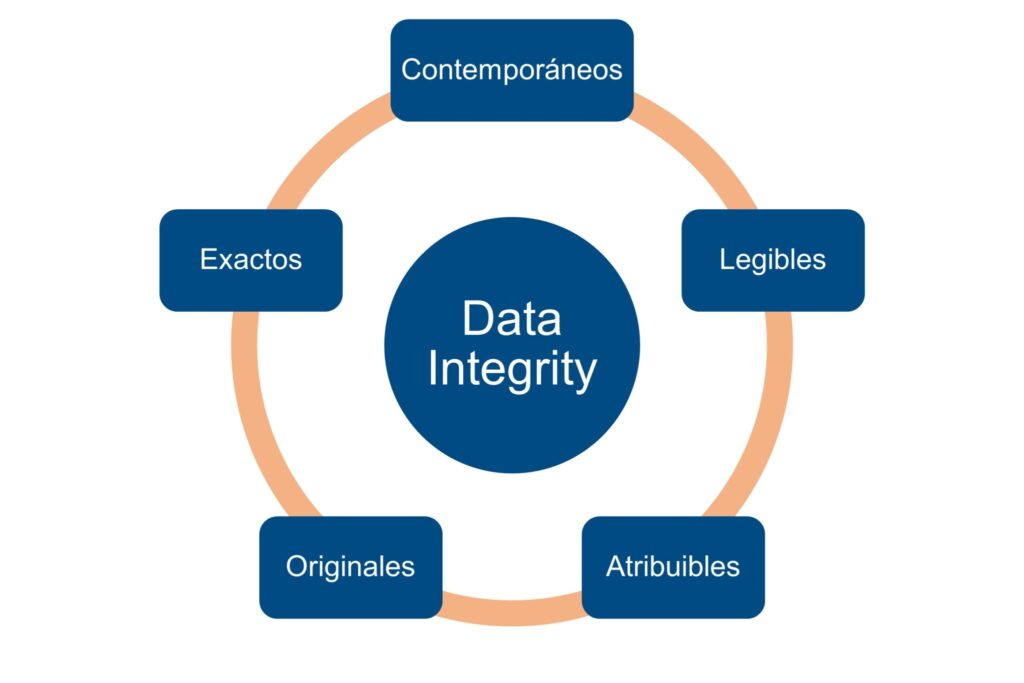
The preparation of the plan must be based on the ALCOA+ principles, widely recognized by regulatory authorities.
The data must be:
| ALCOA Principles | Additional principles (ALCOA+) |
| Attributable: Each piece of data must be able to be unequivocally linked to the person or system that generated it. | Full- All data, including original records, modifications, replays, invalid results, and associated metadata must be preserved and available. |
| Legible: Data must be clear, permanent and understandable throughout its life cycle. | Consistent: The data must follow a logical and chronological sequence, faithfully reflecting the order in which the activities occurred. |
| Contemporary- Data must be recorded at the time the activity is carried out. | Lasting- Data must be recorded and maintained on durable media that preserves its integrity for the entire required retention period. |
| Original: The original record or a certified copy that maintains the content and meaning of the original must be retained. | Available– Data must be easily retrievable and queryable when needed for review, audit, investigation or inspection. |
| Exact: the data must faithfully reflect reality, without errors or unauthorized alterations. |
Every DIMP must demonstrate how the organization ensures these principles in its computerized systems and paper records.
Elements to develop an effective Data Integrity Master Plan
Although the structure of a DIMP can vary between organizations, there are a number of elements that should be included to ensure a consistent approach, risk based and aligned with expectations regulatory.
1. Scope definition
Defining the scope constitutes one of the first steps and, probably, one of the most relevant during the preparation of a DIMP. Before establishing controls, identifying risks or planning remedial actions, it is essential to determine what processes, systems and records iswill be included within the data integrity program. Insufficient scope can leave critical areas unassessed, while an overly broad focus can make it difficult to efficiently manage available resources.
To do this, the organization must carry out a comprehensive inventory of the processes and systems that generate, process, transfer, store or archive data with GxP impact. This analysis must cover both the computerized systems such as paper records, since regulatory authorities consider that data integrity principles are applicable regardless of the medium used. The evaluation must consider all the data life cycle, from its initial generation to its archiving or controlled elimination.
Critical systems are usually included within the scope such as laboratory applications, quality management systems, MES solutions (Manufacturing Execution Systems), ERP systems with GxP impact, document management platforms, SCADA, data historians and analytical equipment that generate electronic records. Likewise, it is important to consider interfaces between systems, data transfers and any manual processes that may influence the accuracy, completeness or traceability of the information.
Scope definition should also be supported by a risk-based criticality assessment. This approach allows prioritizing those systems and processes whose information has a direct impact on product quality, the patient safety or the regulatory compliance. In this way, the organization can focus its efforts on the highest risk areas and establish a more efficient and sustainable implementation strategy.
This documentation will facilitate decision making, provide evidence during audits and regulatory inspections, and serve as a reference for future reviews of the Data Integrity program, especially when new technologies, equipment or processes are incorporated within the organization.
2. Evaluation of the current state (Gap Assessment)
Once the scope of the DIMP has been defined, it is necessary to carry out an evaluation of the current state of the organization to identify possible deviations from regulatory requirements and applicable good practices. This analysis, known as Gap Assessment, provides an objective view of the existing level of maturity and forms the basis for developing an effective action plan.
The evaluation should cover both computerized systems and the processes and procedures associated with GxP data management. Among the aspects usually reviewed are user and access management, the existence and review of Audit Trails, backup copies, data archiving, electronic signature management, segregation of duties and controls to ensure the traceability of information. Likewise, it is important to analyze operating procedures and work practices to verify that they adequately support ALCOA+ principles.
The review should also include equipment and instruments that generate or store critical data, paying special attention to legacy systems or systems with limited functionality that may represent a risk to data integrity.
The findings identified during the Gap Assessment They should be classified based on their criticality and potential impact on product quality, patient safety, and regulatory compliance. This risk-based approach allows remedial actions to be prioritized and resource allocation optimized.
The final result is usually documented in a report that includes the gaps detected, their risk level and the associated recommendations. This document becomes a key element to define the improvement strategy and establish the actions that will be part of the DIMP.
3. Data Integrity Risk Analysis based on ICH Q9
After identifying the existing gaps through the Gap Assessment, the next step is to evaluate the risks associated with data integrity. This analysis allows us to determine which vulnerabilities can compromise the reliability, traceability, availability O accuracy of GxP information and, therefore, must be addressed as a priority.
Risk analysis should adopt an approach based on the principles of Quality Risk Management collected in ICH Q9, evaluating both the probability of occurrence and the potential impact on product quality, patient safety and regulatory compliance. In this way, the organization can concentrate its efforts on those systems and processes that represent the greatest exposure to risk.
During this phase, aspects such as access management, change control, review of Audit Trails, protection against data loss, technological obsolescence or the existence of manual processes likely to generate errors or involuntary manipulations.
Examples of common risks in Data Integrity
| Identified risk | Potential impact | Example of mitigating action |
| Shared user accounts | Loss of traceability and attribution of actions | Implement unique users and formal access management |
| Absence of Audit Trail | Impossibility of reconstructing modifications made to the data | Update or replace the system |
| Unverified backups | Permanent loss of critical information | Perform periodic restoration tests |
| Obsolete systems (legacy systems) | Limitations to meet current regulatory requirements | Establish compensatory controls or replacement plan |
| Poorly controlled manual records | Transcription errors or unjustified modifications | Review procedures and reinforce training |
| Excessive user privileges | Unauthorized modification or deletion of data | Apply segregation of duties and periodic review of permits |
Once the risks have been identified and evaluated, they must be classified according to their criticality to establish priorities for action. The result will be a roadmap that allows defining remediation actions proportional to the level of risk detected and aligned with the DIMP objectives.
Ultimately, a robust risk analysis not only helps prevent regulatory observations, but also facilitates more efficient management of resources, focusing efforts where there is truly the greatest impact for quality and GMP compliance.
Example of risk classification matrix
| Risk level | Description | Action priority |
| Alto | Risk with direct impact on product quality or regulatory compliance | Immediate |
| Half | Risk with partial controls or moderate impact | Short term |
| Low | Risk adequately controlled or with limited impact | Periodic monitoring |
The combination of a Gap Assessment and a well-structured risk analysis allows a list of deficiencies to be transformed into a prioritized remediation plan, justifiable in the face of audits and regulatory inspections.
4. Data Integrity Gap Closure and Remediation Plan
Once the gaps have been identified and the risks have been assessed, the organization must define a remediation strategy that allows correct detected deficiencies and reduce risk exposure. Actions must be prioritized based on their criticality and planned realistically to guarantee their implementation and monitoring.
Once gaps are detected, the plan must include concrete actions to correct them.
Some common examples are:
- Implementation of Audit Trail.
- Updating obsolete software.
- Reconfiguration of user privileges.
- Implementation of electronic signatures.
- Replacement of equipment not compatible with regulatory requirements.
- Review of internal procedures.
Each action must incorporate a person responsible, a target date, priority level and execution status.
5. Governance, roles and responsibilities in Data Integrity
Data integrity is a shared responsibility that must involve the entire organization. Although the Quality Assurance area typically leads Data Integrity initiatives, its success depends on the active participation of all departments that generate, manage or maintain GxP data. For this reason, the DIMP must establish a clear governance model, defining responsibilities, levels of authority and supervision mechanisms.
An effective governance framework ensures consistent application of Data Integrity requirements, facilitates decision-making, and ensures that improvement actions are implemented in a coordinated manner throughout the organization. In addition, it demonstrates management's commitment to data protection and reliability in audits and inspections.
Responsibilities are usually distributed among the different areas as follows:
- Address- Provide the necessary resources and promote an organizational culture based on data integrity.
- Quality Assurance (QA): define the Data Integrity strategy, monitor compliance and coordinate improvement actions.
- Information Technologies (IT): manage the technological infrastructure, access, backup copies and cybersecurity of the systems.
- Engineering and Automation: ensure that systems and equipment maintain adequate controls throughout their life cycle.
- Production and Laboratory: generate and manage data in accordance with established procedures and ALCOA+ principles.
- Validation and CSV: Verify that computerized systems meet regulatory requirements and maintain their validated status.
As a good practice, many organizations establish a Data Integrity Committee made up of representatives from key areas. This committee periodically reviews program indicators, evaluates emerging risks, monitors remediation actions, and promotes continuous improvement.
Clear definition of roles and responsibilities not only contributes to more effective management of data integrity, but also minimizes the possibility of errors, duplications or gaps in responsibility that may compromise regulatory compliance.
6. Training and organizational culture in GMP environments
Technology and procedures are essential elements to ensure data integrity, but alone they are not sufficient. Many of the deviations observed during audits and inspections have their origin in human error, lack of knowledge of applicable requirements or inadequate practices in information management. Therefore, the DIMP must include a continuing training program to ensure that all staff understand their role in protecting GxP data.
Training must be adapted to the roles and responsibilities of each group, addressing both regulatory requirements and good practices applicable to the organization's processes. Likewise, it is important to foster an organizational culture in which Data integrity is perceived as a shared responsibility and an essential element for quality and patient safety.
Key Elements of the Data Integrity Training Program
| Aspect | Aim | Target audience | Recommended frequency |
| ALCOA+ principles | Understand the fundamentals of data integrity | All GxP staff | Initial training and annual recycling |
| Regulatory requirements | Know the expectations of FDA, EMA, MHRA and PIC/S | QA, CSV, IT and area managers | Annual or due to regulatory changes |
| Use of computerized systems | Ensure correct use of critical functionalities | GxP system users | Before use and after updates |
| Audit Trail Management | Understand the importance of data traceability | QA, Laboratory and Production | Periodic according to criticality |
| Good documentation practices | Avoid errors in electronic and paper records | All GxP staff | Annual |
| Management of deviations and anomalies | Promote early detection and communication of incidents | All staff | Annual |
7. Maintenance and continuous improvement of the Data Integrity program
Data integrity should not be considered a one-time project, but rather an ongoing process that requires monitoring and adaptation over time. Computerized systems evolve, processes change and regulatory requirements are updated, so it is essential to have a plan that guarantees the maintenance of the achieved compliance status.
The DIMP must establish periodic activities aimed at verifying the effectiveness of the controls implemented and identifying new opportunities for improvement. These activities include risk review, monitoring of performance indicators (KPIs), internal audits, review of Audit Trails and the evaluation of incidents or deviations related to data management.
Likewise, any change that affects systems, processes or infrastructures must be managed through a formal change control procedure, previously evaluating its possible impact on the integrity of the data. This approach ensures that new implementations, software updates or operational modifications do not introduce undetected risks.
Lastly, the program must consider periodic reviews of the Master Plan itself to ensure that remains aligned with the operational reality of the organization and current regulatory expectations. Continuous improvement not only helps maintain GMP compliance, but also strengthens confidence in the quality and reliability of the data used for decision making.
Conclusion
The DIMP is a fundamental piece of any modern GMP compliance strategy. Its correct preparation allows you to identify risks, prioritize resources and implement effective controls that guarantee the integrity of the data throughout its life cycle. In an increasingly digitalized environment, organizations that take a proactive, risk-based approach strengthen their ability to meet regulatory expectations and maintain confidence in their processes and products.
Contact our specialists to evaluate the maturity status of your organization and develop a Data Integrity strategy adapted to your processes, systems and compliance objectives.