
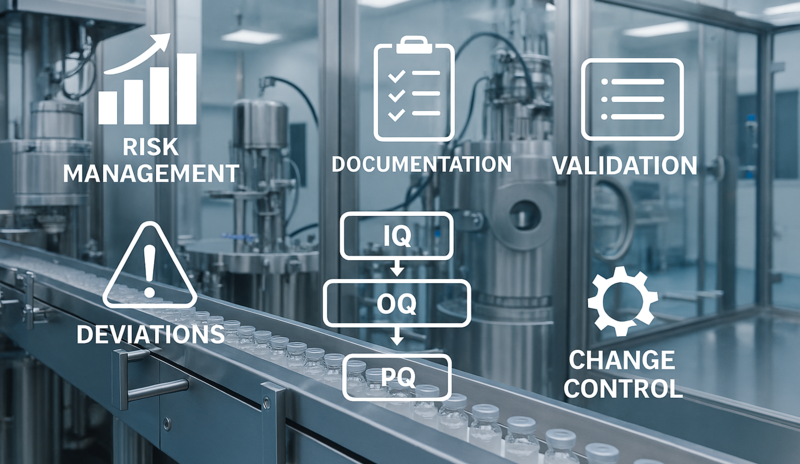
Many technically correct pharmaceutical projects end up generating deviations, delays in qualification or difficulties in inspection for a common reason: quality is not integrated from the beginning, it is tried to be demonstrated at the end.
In this second installment we address how to apply quality operationally throughout the entire project life cycle, from risk management to supplier supervision, aligning technical execution and regulatory compliance.
1. Risk management as the central axis of the project
Risk management, according to ICH Q9, is not a documentary exercise, but rather the element that connects design, execution and validation.
Applying it from the conceptual phase allows:
- Identify what really impacts quality (CQA, CPP, data integrity)
- Avoid over-engineering in non-critical systems
- Focus resources on what is GMP-relevant
Practical example: A poorly defined control architecture in an automated system can compromise data integrity. Detecting it in design avoids rework in OQ.
During the design phase, risk analysis must be actively integrated with technical decisions. It is not only about listing possible failures, but about understanding how every engineering choice (materials, control logic, layout, flow segregation) impacts the probability and severity of critical risks. This approach allows for building inherently more robust systems, rather than relying exclusively on downstream controls.
Furthermore, risk analysis is a dynamic element that must evolve with the project. As more knowledge of the system is gained (for example, after FAT or during installation) new risks or change the existing. Keeping this analysis up to date ensures that subsequent decisions (testing, changes, acceptance of deviations) remain aligned with the operational reality of the system.
Without a risk-based approach, projects tend to overdocument the irrelevant and undercontrol the critical.
2. Document control and traceability
In the GMP environment, documentation does not accompany the project: is the project from a regulatory point of view.
Traceability ensures that each user requirement (URS):
- You have a design solution
- An associated risk analysis
- And a documented verification
Practical example: A critical requirement without traceability to OQ testing can invalidate the defensibility of the entire system under inspection.
An effective document control system not only organizes information, but also ensures coherence between disciplines. Engineering, automation, validation and quality generate documentation simultaneously, and without a structured framework, inconsistencies may appear between documents that describe the same system from different perspectives. These inconsistencies are one of the most frequent findings in audits.
On the other hand, traceability should not be understood as a rigid or excessively bureaucratic exercise. When well designed, it facilitates review, accelerates decision making and allows the impact of changes or deviations to be quickly identified. Tools such as traceability matrices or digital document management systems can provide efficiency, as long as they are aligned with the criticality of the project.
Excess documentation without technical criteria is as problematic as lack of documentation.
3. Project change management
Change is inevitable. The critical thing is how it is managed.
A robust system of change control allows each modification to be evaluated in terms of:
- Impact on quality
- Validation status
- Residual risk
Practical example: A minor change to a sensor may seem irrelevant, but if it affects a CPP, it may require partial OQ rerun.
Furthermore, change management acts as original design integrity protection mechanism. In long-term projects, it is common for small accumulated modifications to significantly alter the initial configuration of the system. Without a structured evaluation, these changes can modify the risk profile without a global reassessment, generating non-obvious vulnerabilities.
Another key aspect is anticipation. Evaluating the impact of the change before its implementation allows define preventive actions, such as expanding evidence, updating documents or reviewing risk analysis. When this evaluation is done after the fact, the project enters a reactive mode that increases costs, rework, and regulatory exposure.
A good change system does not slow down the project: it avoids rework and reactive decisions.
4. Deviation management during the project
Deviations are not an anomaly, but rather a constant in complex projects.
The difference is in its treatment.
Mature management involves:
- Accurate description of the event
- Objective impact assessment
- Real root cause analysis (not superficial)
Practical example: Repetitive deviations in FAT are usually related to ambiguities in specifications, not to technical failures of the supplier.
The real value of deviation management lies in its ability to generate knowledge. Each correctly analyzed deviation provides information about design weaknesses, of the process a from communication between teams. This learning allows us to improve not only the current project, but also future developments.
Furthermore, proper classification of deviations based on their criticality is essential for prioritizing resources. Not all require the same level of investigation or the same depth of corrective actions. A risk-based approach allows concentrate efforts on those deviations with potential impact on quality or compliance, avoiding both the overreaction and the undervaluation of relevant problems.
The absence of deviations does not generate regulatory confidence; its correct management, yes.
5. Integration with qualification and validation
The qualification (IQ/OQ/PQ) is where it is evident whether the project has been well executed… or not.
Under the ICH Q10 framework, validation should be the logical consequence of the design and risk analysis.
To achieve this:
- Each test must be linked to a requirement
- Each requirement must have technical justification
- Every decision must be traceable
Practical example: OQ protocols without a clear link to identified risks often result in redundant or insufficient testing.
Early integration between engineering and validation is a critical success factor. When teams work in isolation, systems are often designed without considering how they will be verified later, creating difficulties during qualification. On the contrary, an integrated approach allows defining from the beginning Consistent and efficient testing strategies.
Likewise, the application of a life cycle approach implies that validation does not end with PQ execution. The information generated during the project must serve as a basis for future operation, including maintenance, revalidations and change management. This continuity is key to guaranteeing the sustainability of the system over time.
When there is no prior integration, validation becomes a costly and lengthy corrective phase.
6. Supplier management and external quality
Suppliers are part of the project quality system.
It is not enough to evaluate technical capacity; It is essential to assess:
- Knowledge of the GMP environment
- Document capacity
- Alignment with validation requirements
Practical example: A supplier with excellent engineering but without GMP culture can generate non-traceable documentation, compromising qualification.
The relationship with suppliers must be managed proactively and not solely contractually. This involves clearly defining expectations from early stages, reviewing design documentation, and maintaining fluid communication throughout the project. Lack of initial alignment often results in deviations during FAT or deliverables that do not meet regulatory requirements.
Additionally, quality involvement (QA) in supplier oversight provides an additional layer of control. His involvement in technical reviews, FAT O documentation evaluation allows you to identify risks from a regulatory perspective, complementing the purely engineering vision.
An unmanaged supplier is a direct source of future deviations.
7. Conclusion
Integrating quality from the beginning of the project allows:
- Make technical decisions based on risk
- Maintain documentary consistency
- Control changes and deviations in a structured way
- Align design, execution and validation
The result is projects:
- More robust
- More efficient
- And fully defensible before inspections by organizations such as the European Medicines Agency or the FDA.
How can we help you?
If you are developing or executing a pharmaceutical project, we can help you:
- Implement a risk management strategy aligned with ICH Q9
- Optimize your qualification and validation approach
- Strengthen documentary control and traceability
- Evaluate changes and deviations with technical criteria
Request a technical review of your project and detect risks before they impact qualification or an inspection.