
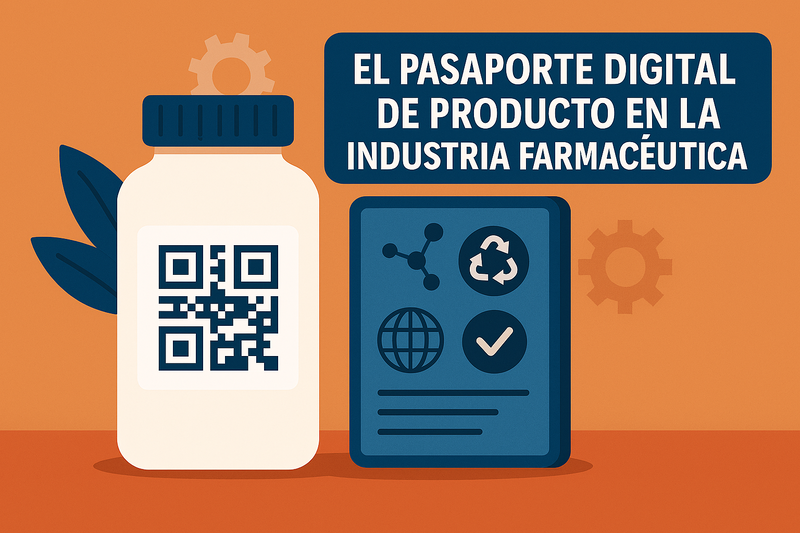
In the pharmaceutical industry, traceability is not an option: it is a critical requirement. However, the new Digital Product Passport (DPP) takes this concept to a completely different level.
The question is no longer just if we can draw a lot, but if we are able to integrate, validate and maintain data dynamics of sustainability, composition and circularity throughout the entire product life cycle.
With the entry into force of the framework promoted by the European Commission through the Ecodesign for Sustainable Products Regulation, the DPP ceases to be a sustainability initiative and becomes a new design vector in process engineering.
1. What is DPP from a plant perspective?
The DPP is a structured data system that physically accompanies the product through a unique identifier (QR, RFID or equivalent), providing access to critical information in real time.
In a GMP environment, this means:
- Extend directly from classic batch-based traceability and batch record towards a much broader model, which incorporates detailed information on the composition, the environmental footprint and the circularity criteria and end of life.
- Ensure that this data meets with pintegrity principles (ALCOA+).
- Ensure that the systems that managed are validated.
In this context, the DPP integrates critical information such as chemical composition (including substances of special concern), environmental indicators such as CO₂ emissions or resource consumption, and the technical instructions necessary for reuse or recycling.
2. Technical circularity: real impact on operations
Technical circularity is based on a clear premise: it is not possible to recover, reuse or recycle materials efficiently if precise information about their composition and behavior is not available. In this context, the DPP acts as a direct enabler of strategies which, until now, were difficult to implement systematically.
In practice, this translates into relevant operational improvements within the pharmaceutical industry. For example, it allows more efficient management of complex packaging, such as blister packs or multilayer materials, facilitates reverse logistics and provides greater transparency about the materials in contact with the product. All of this contributes to reduce uncertainty in processes which have traditionally been limited by the lack of structured data.
3. The real challenge: engineering, integration and GMP compliance
The implementation of the DPP cannot be approached as an isolated digitalization project. Its impact crosses multiple layers of the organization and, especially, GxP systems, where any change must be controlled and validated.
| Systems interoperability | It is one of the main challenges. The need to connect platforms such as ERP, MES, LIMS or PLM under open standards (such as those promoted by the ISO) forces us to redesign data architectures that have traditionally evolved independently. This point is not minor: the quality of the DPP will directly depend on the consistency and traceability of these integrations. |
| Validation and compliance | The information contained in the DPP must comply with the integrity principles established in the EU GMP Guidelines, which implies validating both systems and data flows. Additionally, any modifications to these environments must be managed through formal Change Control processes, which adds complexity to their deployment. |
| Equipment adaptation | The incorporation of digital identifiers in packaging lines, together with high-speed verification systems and artificial vision technologies, makes DPP a requirement that directly affects the design and qualification of facilities. |
4. Operational benefits (beyond compliance)
Although the impulse is regulatory, the impact on the plant is tangible:
- More efficient audits: immediate access to structured data
- Reduction of operational errors: automatic material verification
- Supply chain optimization: better knowledge of raw materials
- New operating models: transition to Product-as-a-Service
In this context, data stops being documentation and becomes operational infrastructure.
5. Regulatory framework: practical implications of the ESPR
The Ecodesign for Sustainable Products Regulation (ESPR) introduces a structural change to the way products should be be designed, document and manage in the European Union. Although its scope is broad, it includes particularities for sectors such as pharmaceuticals, where it coexists with specific regulatory frameworks.
In practical terms, this means that companies must prepare to manage sustainability data dynamically, integrating this information within their existing systems. Likewise, it reinforces the nneed to connect the physical product with its digital representation through robust and standardized identifiers.
Another relevant aspect is the evolution of corporate systems. Tools such as ERP or PLM cease to be repositories of static information and become platforms capable of generating and updating product attributes throughout its life cycle, which requires an in-depth review of its architecture and governance.
6. Practical example: implementation in a chemical plant
Let's imagine a plant that produces Sodium Lauryl Ether Sulfate (SLES) intended for the cosmetic sector. To comply with DPP requirements, each container - IBC or drum - incorporates a physical identifier, such as an industrial QR code or RFID chip. This identifier is designed to resist the chemical conditions of the process and meets international standards such as the BS5609 regulation.
Systems integration
The value of the DPP lies not only in the identifier, but in how it connects to plant systems. Each piece of information flows from different sources: the ERP provides the identification data of the lot, the LIMS provides the composition and safety information, the MES captures process parameters in real time, such as energy and resource consumption, and the tools life cycle analysis (LCA) They automatically calculate the environmental footprint. This integration ensures that data is always accessible, validated and consistent, reinforcing traceability and auditability.
Operational flow and circularity
The operational process is adapted so that the DPP is functional: information is captured automatically during production, external certifications such as RSPO for sustainable raw materials, and clear protocols are defined for the management of end of life of packaging. This allows packaging to be safely recovered, cleaned and reused, effectively closing the cycle of technical circularity.
Plant benefits
The operational impact is immediate and tangible. Structured and accessible information allows for almost instant audits, reduces errors in the receipt and handling of raw materials, and provides a level of traceability that was previously only achieved through manual processes and dispersed documentation. In this way, the DPP becomes a operating asset, capable of improving the efficiency, quality and safety of the entire operation, beyond simply meeting regulatory requirements.
7. Implications for engineering and qualification
From an engineering point of view, the DPP introduces requirements that directly affect the qualification of equipment and systems. The incorporation of identification and traceability technologies forces us to review the scope of IQ, OQ and PQ, especially in relation to coding systems, software-hardware integration and online verification.
At the same time, the validation of computerized systems takes on a new dimension. The interfaces between MES, ERP and LIMS cease to be simple functional integrations and become critical elements that must guarantee the integrity and consistency of data throughout the entire product life cycle.
All of this has a clear consequence in the design of new facilities: the data architecture and integration capacity must be considered from the early phases of the project. DPP is not a layer that can be added later without impact; It must be part of the base design of the plant.
Conclusion
The DPP does not add complexity: it makes it visible and manageable. And in GMP environments, what is not designed from the beginning ends up compromising compliance, efficiency or both.
For the pharmaceutical industry, the challenge is not only to comply, but to do so by guaranteeing:
- Data integrity
- Systems validation
- Operational robustness
Circularity without traceability is just an intention; with the DPP, it becomes an engineering design variable.
lines, systems and processes to this new standard requires a combination of engineering, validation and regulatory knowledge. Anticipating will make the difference between complying… or being left out of the market.